Tuesday, March 30, 2010

Sakura


from the bud
a blossom's mind is set
on falling

(Haiku by Robin Gill)

The beautiful weeping cherry tree burst into triumphant bloom for the re-opening of Greenbrier Library. I suspect Virginia Landers had a quiet word with the tree. After all, she’s been here off and on all week with her landscaping crew. Creating a beautiful Zen-like garden where the cherry holds court outside the great curving wall of glass. Tucking a pocket sized garden in each of the three window niches featuring reader’s club chairs. These gardens will be her swan song to Chesapeake.

People in Chesapeake may not know her name, but Virginia Landers has brought significant beauty into their lives. For almost thirty years Virginia has been landscaping the civic grounds of Chesapeake. In late summer the local roads are lined with lushly blooming Crape Myrtles, the City’s official tree. Virginia helped plant hundreds as part of the Chesapeake Beautification Program between 1989 and 1995. These trees in bloom are one of the most striking features of the cityscape. Washington, D.C. has Cherry trees, but the City of Chesapeake has Crape Myrtles.

Wandering around the park-like City Hall Campus on Cedar Road there are many wonderful discoveries. A small bridge and walk curve through a naturalized area connecting the parking lots and City Hall. Drifts of daffodils and snow drops fill woods that are full of birdsong. Star Magnolias and three miniature “Razzle Dazzle” Crape Myrtles spangle gorgeous blossoms outside the library. When the Fringe Tree blooms the fragrance is so heady and evocative that patrons reel into the library asking “What is that tree?”


Virginia was born to the gardening life as the child of a Norfolk landscaping family. She recalls that it was her father’s beloved Camellia bushes that first captivated her imagination. Virginia studied botany and dendrology (the study of trees) at Frederick College. Last week, she was behind the library working with her crew; kneeling, shoveling, and sowing. She rattles off the plant names in Latin, like the names of her children. She describes how the new garden will look gesturing with her hands, outlining a flowing umbrella shape as she explains how the bush will grow to fill the corner of the building.


Her hands are unapologetically weathered, brown, and capable. As a relative newcomer I ask her what grows well in Chesapeake. She responds, generous with her knowledge in the way of gardeners.

“All kinds of magnolias thrive here, and azaleas with the right partial shade and acidic, organic soil. Scuppernong grapes, peaches, not apples, it doesn’t get cold enough for them. Nandina bushes, Bermuda grass, which is the native grass, Camellias, and Chinese Holly. Bald Cypress trees do very well here; even in dry median strips, although they are a wetland plant. Butterfly Bushes, willows, and of course, Crape Myrtle, which can take the car exhausts. The herbaceous perennials often don’t do as well. This is a transitional area between zones 7 and 8, northern and southern plants will grow here, but sometimes the conditions can be difficult for each.”

She enthusiastically recommends her favorite reference source. Best Plants for Hampton Roads: A Landscape & Garden Companion (co-authored by Dawn Alleman, Ed Bradley, Laurie Fox, Norman Grose, Brenda Johnson-Asnicar, Sherry Kern, Eva Lynn Trump and Jim Williams). Virginia suggests visiting the Botanical Garden in Norfolk, which has a great horticultural shop. Although her passion is undiminished, Virginia is retiring on June 30th. When I read up on cherry trees, and their prominent role in Japanese culture, I realize what a fitting finale garden she created.

The Japanese call cherry blossoms sakura, which is also the name of the time of year when they bloom, a time to gather with friends and celebrate the beauty of spring and life. In Japan, the life cycle of the cherry blossom is emblematic of the beauty, fragility, and fleeting nature of all of life. The sakura season provides an annual reminder that life is glorious and passes swiftly, and that each fleeting moment is precious. It is a time to ponder your accomplishments and to think ahead of remains undone.

Virginia is leaving behind a wonderful legacy of beauty for her community. She has good reason to celebrate her achievements with friends as she gazes forward to her new life.


after sunset
the moon and i toast
the blossoms

(Robin Gill)
Betsy Fowler

Saturday, March 20, 2010

A Sense of Place


Who knows how long this will last
Now we’ve come so far so fast
Somewhere back in the dust
That same small town in each of us
(The End of the Innocence lyrics by Don Henley)


On a snowy Christmas Eve in 1945, a young man stood on board the train slowly pulling into the South Norfolk train station. Two long years had passed since he had seen his home and family.
He was just seventeen when he signed up for six years in the new naval aviation program. His father went with him to notarize the papers at the confectionary on Poindexter Street. Mr. White, the shop owner and local notary, wisely observed, “I can help get you in, but I can’t help get you out.”
The young man thought of that statement later when he was stationed in the Pacific Theater, where a series of small tropical islands was ravaged by some of the most savage fighting the world has ever known. However, he did survive the war, and the rest of the century that followed.


Raymond Harper was born in South Norfolk, a city of the first class, in March 1928. Born into a world where streetcar lines ran from South Norfolk to downtown Norfolk, where the Jordan Bridge was a symbol of modern progress, and most of the cataclysmic events that would define the twentieth century still lay on the horizon; far beyond the realm of anyone’s imagination.

In 2010, there is more to South Norfolk than meets the eye.

The old independent city of South Norfolk still lives on in the memory of many Chesapeake residents. People who vividly recall being raised in the tree lined streets running between Bainbridge Street and Chesapeake Avenue, in frame houses with generous front porches designed for summer socializing in those pre-air conditioned scorching Southern summers.


The natives of old South Norfolk recall a tightly knit community. A place where the front doors were never locked. A place where you knew and greeted everyone you passed on the street. A place where you walked down to Preston’s Drugstore at the corner of Poindexter Street, B Street, and Chesapeake Avenue for a milkshake and a visit with friends.

One of my co-workers, who grew up on Jackson Street in South Norfolk, says simply, “It was really something special back then.” And I believe her, because I have met so many people who still carry around that powerful sense of place and belonging about the old city.


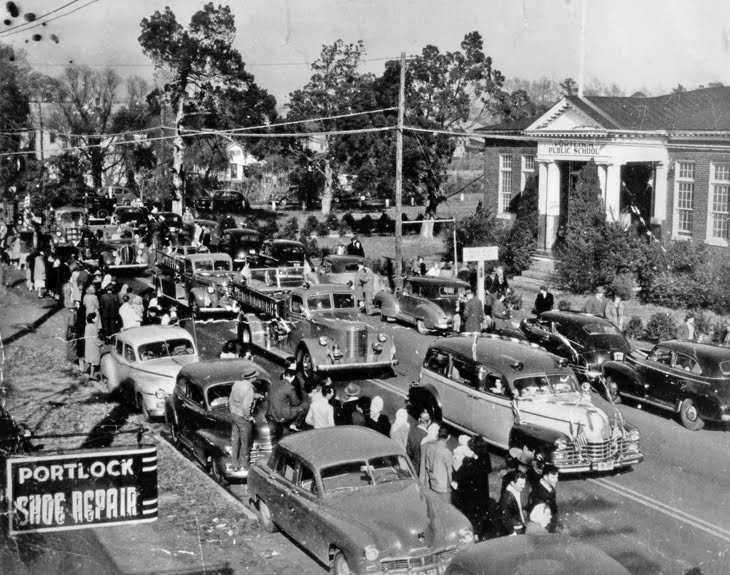
Raymond Harper was one of a group of bright, high spirited South Norfolk sons and daughters who kicked up their heels, and then settled down to become many of the citizens who would shape the future of the new City of Chesapeake. Sheriff Newhart, Judge Preston Grissom, Judge Forehand, Bobby Clifton, Raymond Jones, Maury Brickhouse, and many others hailed from South Norfolk and Portlock.

Most of the old gang moved to other neighborhoods during the decades following the establishment of the new City of Chesapeake in 1963. South Norfolk, like so many other traditional American cities and towns, was ravaged in the late twentieth century by the urban migration to the suburbs and the accompanying movement of commerce to new shopping centers.

However, the old city is on the rise once again. The neighborhoods still retain many of the characteristics urban planners now know make a community livable. A walkable grid of sidewalks and tree lined streets, churches, and fine old homes, where young families still push strollers on warm summer evenings. There are green spaces such as the lovely old Lakeside Park. There is a local Historic District and a National Historic District.

There is still that unmistakable sense of place.

In recent years a new vision has emerged for South Norfolk. The City, working with local residents and business people, has created a South Norfolk TIF (Tax Increment Funding) District. The TIF is providing funding for the South Norfolk Strategic Plan, which is now underway. The Council, led by Mayor Krasnoff, and the Department of Economic Development, has approved the construction of a new public library on Poindexter Street. The library will be South Norfolk’s first TIF funded public building.

The investment in the library will play a key role in the revitalization of the Poindexter streetscape. The business world has realized that public libraries make great economic anchors for town centers and shopping areas. Open seven days a week, and most evenings, a busy public library can easily draw almost a thousand people a day, and help create a vibrant town center. Many people combine trips to the library with other errands like shopping or eating. That means library users visit surrounding businesses.

The library provides a civic presence, a source of entertainment and education, and acts as a commercial driver. Libraries also help anchor communities by providing a neutral public setting for people to meet, learn, and connect with ideas, information, and each other.


Design work is scheduled to begin next month for the library project. Seeking community input will be one of the first steps in the process. Remember that young soldier Raymond Harper? He now serves on the Library Advisory Board, and is planning on donating his extensive South Norfolk history collection to the new library. Soon people will be able to walk down Poindexter Street to go shopping, go out to lunch, get a cup of coffee, read the paper, greet their neighbors, and visit a beautiful new library. And Raymond Harper? He will be there too.

Betsy Fowler

(All photos courtesy of Raymond Harper)

Wednesday, March 10, 2010

Bringing Home the Bacon


Exploring my new home base of Hampton Roads I make a wonderful discovery! A small Suffolk establishment, widely known to locals, called Bennett’s Creek Farm Market. As native as peanuts, pigs, and pines, this grocery store is an authentic, down home kind of place.

As part of my Tidewater cultural immersion I have been seeking out the local cuisine. Bennett’s serves it all up in a South of the James smorgasbord; with great items such as Hula Girl BBQ Sauce from Virginia Beach and Reggie’s Banana Pudding Sauce “It’s all about the Pudding!” distributed from Chesapeake.

On my first shopping foray I purchase fresh local pork chops, sausage, and bacon. Later that evening I pan grill the pork chops and serve them with bourbon sauce. Bliss! The next morning we go hog wild, so to speak, and cook up a slab of bacon, spicy sausage, brown farm eggs, and thick slices of whole wheat toast with comb filled honey (from Bennett’s as well). The bacon boldly steals the show.

I romantically envision the bacon being locally cured in a small cone roofed wooden smokehouse, although it is probably processed in a cinderblock building on a concrete pad. Chewy, salty, and delicious, it is as far removed from standard bacon as today’s catch of fresh fish is from a can of tuna. I am ruined or ‘ruint’. I immediately start planning a brunch, envisioning a table laden with this astonishing bacon, spicy sausage, cheese grits, ham biscuits, creamy eggs; you get the idea.

I imagine the menu description if this feast was served up at Emeril’s in New Orleans. “Thick rustic hand cut slabs of hickory smoked Suffolk, Virginia bacon, served with two, large free range chicken eggs, and sweet potato biscuits with wildflower honey.” Eat your heart out Paula Dean, there’s a new girl in town.


All of the recent cold weather gave me a great excuse to stay home and cook. The Library has hundreds of great cookbooks to page through and fantasize over. Some good titles for local recipes are the Best of the Best from Virginia Cookbook: Selected Recipes from Virginia’s Favorite Cookbooks I & II and Cooking the Southern African Way: Culturally Authentic Foods Including Low-fat and Vegetarian Ways. I have also ordered myself a copy of the popular Toast of Tidewater by the Junior League of Norfolk-Virginia Beach for additional inspiration.

Recently, I happened across a charming book entitled Alice Waters and Chez Panisse: The romantic, impractical, often eccentric, ultimately brilliant making of a food revolution by Thomas McNamee. This is the fascinating story of how the fresh, seasonal, local food movement in America was initiated in the late sixties by Alice Waters, a young, free spirit from Berkeley, California. Her restaurant, Chez Panisse, continues to be rated as one of the very best in the country.

A new book about food in America, Food Rules by Michael Pollan, has been receiving a great deal of attention in the media. Pollan urges us to eat healthy, wholesome food by using simple homilies to eloquently illustrate his points. “If it came from a plant, eat it; if it came out of a plant, don’t.” His earlier book, In Defense of Food: an Eater’s Manifesto, is distilled into a simple but powerful directive: “Eat food. Not too much. Mostly plants.” This triplet became a mantra in my household last year (our recent foray into fresh bacon not withstanding).

There are some great local crops for the health conscious eater. I am a recent convert of fresh collards and turnip greens, old fashioned boiled and Asian sautéed; you can’t go wrong either way. My husband has proudly mastered roasting fresh peanuts to perfection in the oven, and a just cracked oyster, served with a dollop of freshly ground horseradish sauce, is my personal idea of perfection.

So let us raise a glass together to our wonderful local cuisine. Here’s looking at you Smithfield. Maybe I’ll even try the souse next time at Bennett’s.


Southern-Style Collard Greens
2 hickory-smoked bacon slices, finely chopped
2 medium-size sweet onions, finely chopped
¼ lb. smoked ham, chopped
6 garlic cloves, finely chopped
3 (32-oz) containers chicken broth
3 (1-lb) packages fresh collard greens, washed and trimmed
1/3 cup apple cider vinegar
1 Tbsp sugar
1 tsp. salt
¼ tsp. pepper

Cook bacon in a 10-qt. stockpot over medium heat 10 to 12 minutes or until almost crisp. Add onion, sauté 8 minutes, add ham and garlic, and sauté 1 minute. Stir in broth and remaining ingredients. Cook 2 hours or to desired degree of tenderness.
(Southern Living November 2009)

Betsy Fowler

Wednesday, March 3, 2010

La Primavera


La Primavera
I am longing for spring. Looking out my kitchen window this cold Saturday morning I can feel the earth starting to rouse; sense the opening refrains to the ancient vernal symphony in the activity at the birdfeeders, the greening of the grass, and the slender stalks of the daffodils defying the recent snow squalls. Oh yes, spring is coming.

The artist Botticelli beautifully heralded the arrival of spring in the Renaissance painting La Primavera. Until I actually stood before the painting I never comprehended the grand scale of the canvas, the exquisite tapestry of small flora on the forest floor of the painting, or noticed that each of the female figures is with child.

As I grow older, passing through the seasons of my own life, I am more keenly aware of the enormous work of birth and new life; regardless of whether you are a bird, a bear, or a human being. Spring makes me appreciate anew the tremendous energy that is required to physically bear offspring, create a safe shelter, and care day in, and day out, for the relentless needs of the young; spiritually, emotionally, and physically.

This month, in the spirit of resurrection, renaissance and spring; the library staff and the community are banding together to re-create the Greenbrier Library. No additional funding for renovation projects is available during these lean times, but the work needs to be done; so we are rolling up our collective sleeves, wading in, and making do. Staff and volunteers have already begun ripping down the peeling wallpaper and cleaning out the debris of two decades. The Sheriff and Public Works has graciously loaned us a hardworking crew of trustees and a good hearted supervising deputy to help library staff paint and move several tons of steel shelving, collections, and furnishings.

In the theme of La Primavera, the Greenbrier Library makeover will be our first “green” project. The “new” shelving and fixtures are being recycled from the Walden Books that recently closed at the Greenbrier Mall and the Dillard store that closed at Chesapeake Square Mall. We are also doing some creative re-adaptation of old existing fixtures. The “new” carpet is recycled fibers and tiles from warehouse remainders from a large commercial project. Shelving and furniture no longer needed by the Library is being re-purposed by the Chesapeake Public School System.

The Greenbrier project is also about rethinking how we provide customer services. We will reopen with a single new adult service desk downstairs to conserve our most precious resource - our staff. Staff will be scheduled to “rove” the building to help patrons as needed. We will feature a new collection layout designed to maximize the natural light, and the views to the golf course, from the wide curving plate glass windows on the rear of the building. The use of light and color, signage produced by library staff, and a new floor plan, will all encourage library patrons to enjoy the collections featured on the new recycled display shelving. All of the computers and tables will be grouped with reference services on the second floor for work and quiet study.

We are planning to open the doors on Monday, March 22nd. So do plan to come and visit! However, you may not see me, because I am hoping to complete this project on schedule, and then perhaps, perchance, to steal away for a day or two and revel in the wonders of spring.

“The Mole had been working very hard all the morning, spring-cleaning his little home. First with brooms, then with dusters; then on ladders and steps and chairs, with a brush and a pail of whitewash; till he had dust in his throat and eyes, and splashes of whitewash all over his black fur, and an aching back and weary arms. Spring was moving in the air above and in the earth below and around him, penetrating even his dark and lowly little house with its spirit of divine discontent and longing. It was small wonder, then, that he suddenly flung down his brush on the floor, said ‘Bother!’ and ‘O blow!’ and also ‘Hang spring-cleaning!’ and bolted out of the house without even waiting to put on his coat.


(The Wind in the Willows by Kenneth Graham, Chapter 1, “The Riverbank”)